


Japanese Book Nook Kits
Kyoto alleys, cherry trees and paper lanterns, in wood and warm light.
-
Book Nook Little Izakaya — Japanese Mini Kit with LED
Regular price £41.00Regular price £41.00 Sale priceUnit price per£69.0040% -
Book Nook Kyoto Alley — Japanese Wooden Kit with LED
Regular price £56.00Regular price £56.00 Sale priceUnit price per -
Japanese Miniature House Kit with LED — The Cherry Blossom Parlor
Regular price £61.00Regular price £61.00 Sale priceUnit price per -
Japanese Miniature House Kit with LED — The Hanamiya Sweet Shop
Regular price £63.00Regular price £63.00 Sale priceUnit price per -
Japanese Miniature House Kit with LED — The Showa Café
Regular price £65.00Regular price £65.00 Sale priceUnit price per -
Japanese Miniature House Kit with LED — The Cherry Blossom House
Regular price £66.00Regular price £66.00 Sale priceUnit price per -
Book Nook Sakura Rain — Japanese Wooden Kit with LED
Regular price £71.00Regular price £71.00 Sale priceUnit price per -
Japanese Miniature House Kit with LED — The Bonsai Pavilion
Regular price £75.00Regular price £75.00 Sale priceUnit price per -
Japanese Miniature House Kit with LED — The Kyoto Bazaar
Regular price £77.00Regular price £77.00 Sale priceUnit price per -
Book Nook Sakura Tram — Japanese Wooden Kit
Regular price £86.00Regular price £86.00 Sale priceUnit price per

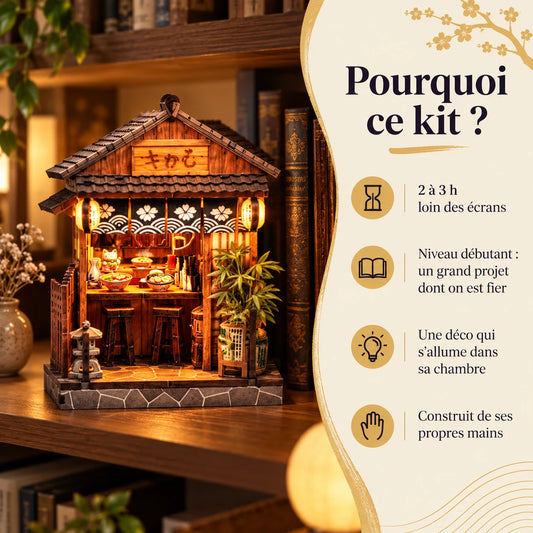



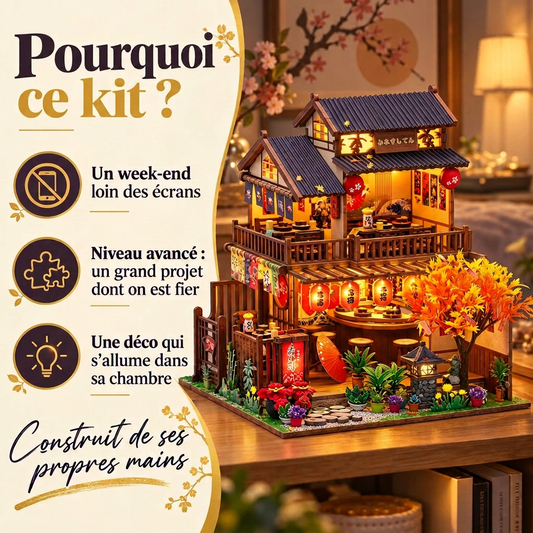


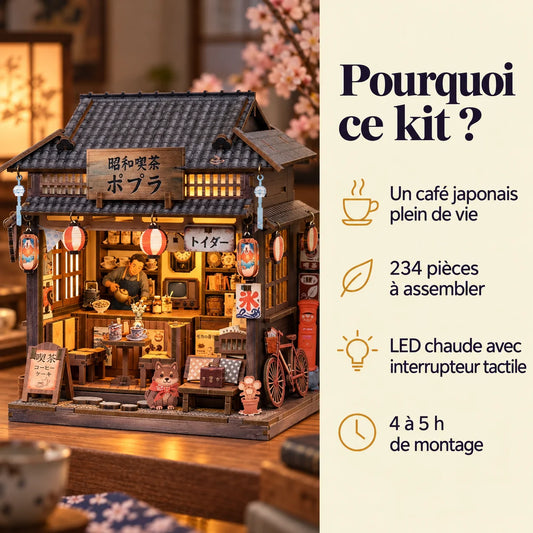

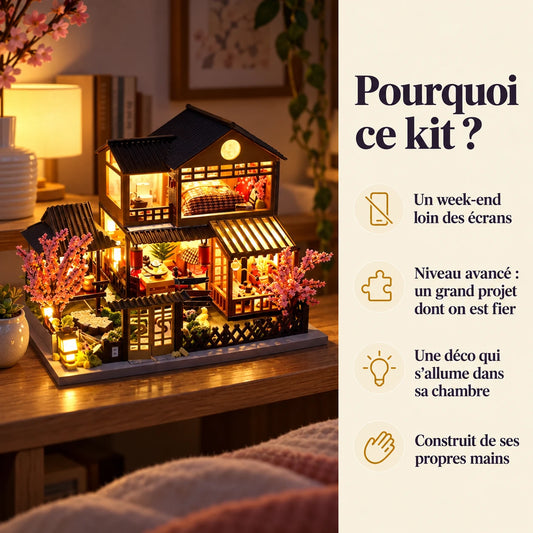

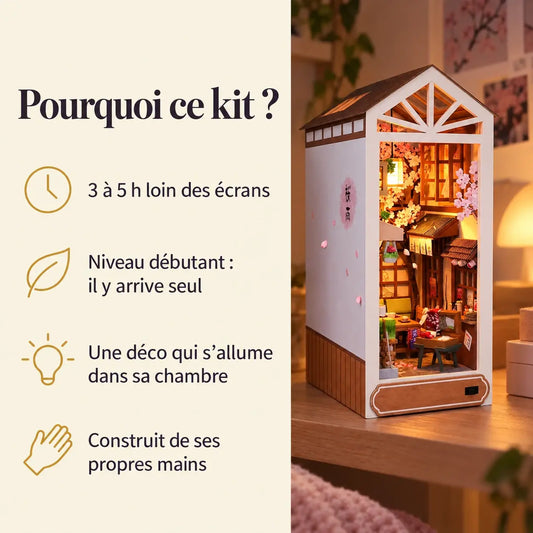

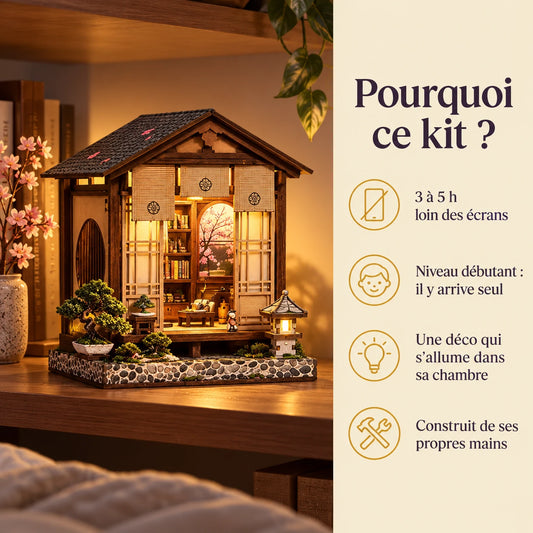

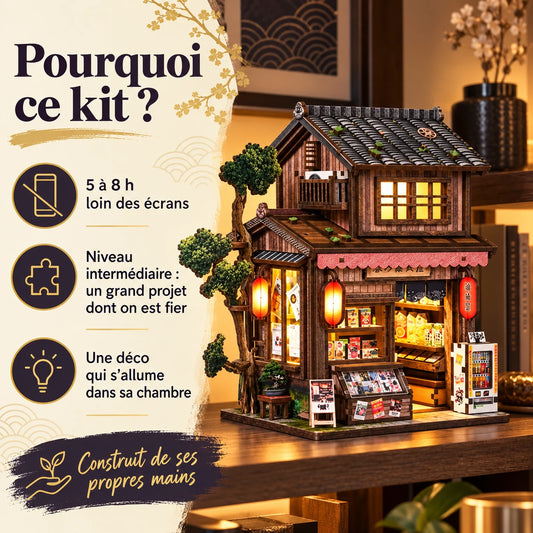

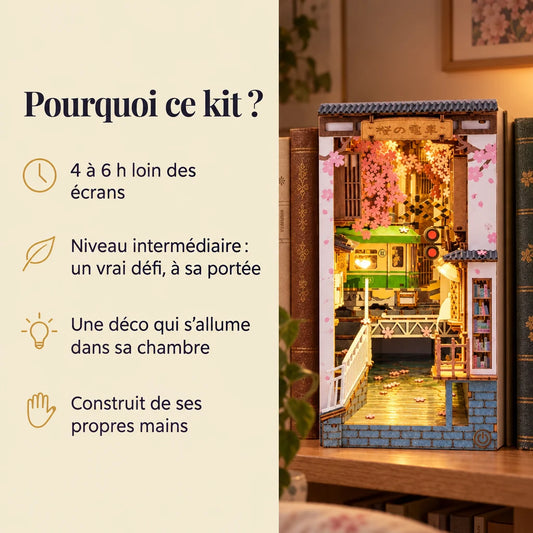
Japan is a favorite theme among book nook fans, and it's easy to see why: narrow alleys, paper lanterns, sliding doors and cherry blossoms lend themselves perfectly to a miniature scene tucked between two books. This page brings together all our Japanese book nooks to build yourself—scenes chosen one by one, warm LED included.
Scenes of Japan to build
Kyoto Alley is our entry kit into this world: a narrow alley, shop signs, warm light filtering between the tightly packed facades, and a beginner-level build. It's the quintessential Japanese book nook, the one that instantly gives a bookshelf the feel of a summer evening in Gion.
Sakura Rain places a Japanese shop beneath cherry trees in bloom: the pink petals take the foreground, the shop window lights up behind them, and the scene changes completely depending on whether the LED is off or on. Little Izakaya is our starter format, a Japanese tavern with its red lanterns—ideal for a short first build or as a gift. The Bonsai Pavilion slides open its shoji door onto a zen tea pavilion, with its majestic bonsai.
The sakura book nook, the signature scene of spring
If one scene had to sum up this world, it would be the sakura book nook: pale pink petals in the foreground, a shop window glowing behind, and that contrast between day and night that gives Japan's cherry trees all their charm. Sakura Rain is the Nooko take on it, at beginner level, designed to be given as much as kept: it's the gentle way into Japanese scenes.
Three details set a beautiful sakura kit apart:
- three-dimensional petals, added as separate pieces in the foreground rather than printed: they're what create the depth;
- a warm LED, because pink only comes alive under a golden light;
- at least three layers of scenery: facade, alley and background.
When building, glue the petals on last, once the lighting is installed and tested, and leave some gaps: they let the scene breathe as much as the flowers do. Sakura Rain has 258 pieces and takes 3 to 5 hours to build.
And for those who want to go bigger, there are Japanese miniature houses: The Kyoto Bazaar, a two-level Japanese grocery store overflowing with detail, plus The Cherry Blossom Parlor and The Cherry Blossom House, two multi-story houses beneath the sakura, to set on a piece of furniture rather than between two books. All our standalone Japanese houses are gathered in the Japanese miniature house kits collection. These multi-story houses also appear among our wooden miniature houses.
How to choose your Japanese book nook
Four criteria set the Japanese scenes apart: the mood, the format and build time, the light, then the space on your shelf. The infographic below sums them up at a glance, and each one is explained right after, in the same order.

1. The mood: six families of Japanese scenes
Behind the word "Japanese," you'll find very different scenes. The table helps you spot the one that appeals to you, with one kit to illustrate each family.
| Family | What you build | Most common level | An example |
|---|---|---|---|
| The alley | Tightly packed wooden facades, shop signs, lanterns, power lines | Beginner to intermediate | Kyoto Alley, 223 pieces |
| The shop beneath the cherry trees | A grocery, candy shop or bookstore under an awning, lit shop window | Beginner to intermediate | Sakura Rain, 258 pieces |
| The tavern | A counter, red lanterns, stools and small bowls | Beginner, often in a small format | Little Izakaya, 96 pieces |
| The tea pavilion and garden | Shoji screens, bonsai, dry garden and stones | Beginner to intermediate | The Bonsai Pavilion |
| The multi-story house | A furnished interior on two levels, lit by zone | Intermediate to advanced | The Kyoto Bazaar, 478 pieces |
| The seasonal scene | Cherry blossoms in spring, red maples in fall, snow in winter | Varies | Sakura Tram |
2. Format and build time
This is the criterion that saves you from disappointment: a first kit that's too long often ends up in a drawer. There are three formats:
- the small starter format, around 100 pieces for one evening, like Little Izakaya (96 pieces, 2 to 3 hrs);
- the classic book nook, 200 to 300 pieces for 3 to 5 hrs, like Kyoto Alley or Sakura Rain;
- the multi-story house, 450 pieces and up, from 5 to 8 hrs for The Kyoto Bazaar to a whole weekend for the biggest ones.
3. The light
A Japanese scene is judged in the evening, with the LED on. Look for a warm LED rather than a white one, placed behind the paper screens or under the awnings: that's what creates the lantern effect. Cherry blossom and alley scenes are the ones where the light plays most with the decor, while a tea pavilion offers a softer, calmer glow. How the lighting is powered is listed on each product page.
4. Space on the shelf
A book nook slides between two books, so measure your shelf's height and depth first: multi-story houses, on the other hand, sit on a piece of furniture. Place the scene at eye level, between novels with dark spines so the warm light stands out, and away from direct sunlight, which fades the wood and printed papers. To check what you'll need alongside the kit—wood glue and precision tweezers—it's all in our article what supplies you need to make a book nook.
Why Japan suits book nooks so well
A book nook plays with depth: several stacked layers of wood create perspective, like a small theater stage. And traditional Japanese architecture is made of successive layers—sliding doors, paper screens, awnings, vertical signs—that naturally break the scene into layers. Add lanterns, whose warm light shines through the paper, and you get scenes that seem made to be lit from within.
It's also a world that tells stories: an izakaya at the hour when office workers head home, a shop beneath the cherry trees in spring, a quiet tea pavilion. No Nooko kit is officially licensed: these scenes don't copy any movie, manga or saga. We keep only a handful of models, the ones whose level of detail really holds up once built.
The build, in practice
Each kit contains the laser-cut wood, the decor, warm-white LED lighting and illustrated instructions in English. Regular wood glue (not included) and tweezers are all you need; you build in stages, facade after facade, and the LED goes in at the point shown in the instructions—no electronics knowledge required. Plan two to four evenings for an alley, and one to two relaxed weeks for a multi-story house. For the finest pieces, the precision tweezers that come free with every kit make the work much more comfortable.
Japanese book nook FAQ
What's the easiest Japanese book nook to build?
Little Izakaya, our starter format: few pieces, a short build, an instant effect once the lanterns are lit. Kyoto Alley comes right after, in a classic beginner-level format.
What's the hardest Japanese book nook?
The multi-story houses, like The Kyoto Bazaar and its 478 pieces. The difficulty comes from the number of pieces, the size of the smallest ones and the number of areas to light: best saved for those who've already built a first kit.
Do the Japanese houses also slide between two books?
No: The Kyoto Bazaar, The Cherry Blossom Parlor and The Cherry Blossom House are standalone miniature houses, with several visible facades and floors. You admire them from every angle, on a shelf or a desk.
Are these scenes replicas of real places?
No: they evoke the atmosphere of Japanese neighborhoods without reproducing a specific place, and no kit is officially licensed—no movie, no manga, no saga. It's an atmosphere, not a copied set.
Want to explore other worlds? Find all our book nook kits in one place, switch to nighttime moods with our fantasy book nooks, find the cherry trees and the tea pavilion in our nature book nooks, or the scenes that light up at night in our light-up book nooks. And to see these same scenes from a diorama angle, the dedicated page describes them one by one.
