


Japanese Miniature House Kits
Japanese wooden houses, one sliding door after another.
-
Book Nook Little Izakaya — Japanese Mini Kit with LED
Regular price 39,90€Regular price 39,90€ Sale priceUnit price per66,90€40% -
Japanese Miniature House Kit with LED — The Cherry Blossom Parlor
Regular price 58,90€Regular price 58,90€ Sale priceUnit price per -
Japanese Miniature House Kit with LED — The Hanamiya Sweet Shop
Regular price 60,90€Regular price 60,90€ Sale priceUnit price per -
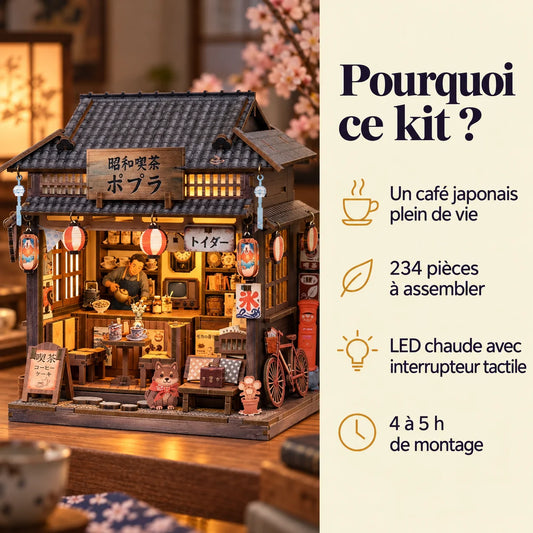
Japanese Miniature House Kit with LED — The Showa Café
Regular price 62,90€Regular price 62,90€ Sale priceUnit price per -
Japanese Miniature House Kit with LED — The Cherry Blossom House
Regular price 63,90€Regular price 63,90€ Sale priceUnit price per -
Japanese Miniature House Kit with LED — The Bonsai Pavilion
Regular price 72,90€Regular price 72,90€ Sale priceUnit price per -
Japanese Miniature House Kit with LED — The Kyoto Bazaar
Regular price 74,90€Regular price 74,90€ Sale priceUnit price per







A Japanese miniature model is a wooden house you build yourself, sliding door after sliding door, until the moment the warm light comes on behind the facades. This page brings together our Japanese miniature houses to build: kits from the tea pavilion to the two-level bazaar, all in laser-cut wood, LED included, with illustrated instructions.
Our Japanese miniature houses to build
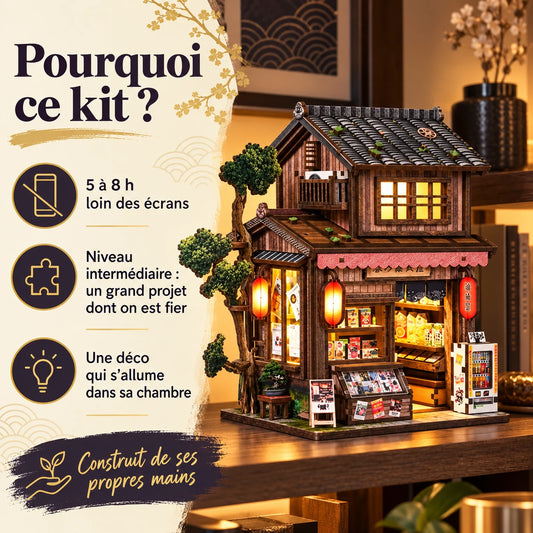
The Kyoto Bazaar is the most detailed of the series: a two-level Japanese grocery store, 478 pieces, stalls and signs everywhere, five to eight hours of intermediate-level building. It's the model you look at up close, because there's always a detail you hadn't noticed.
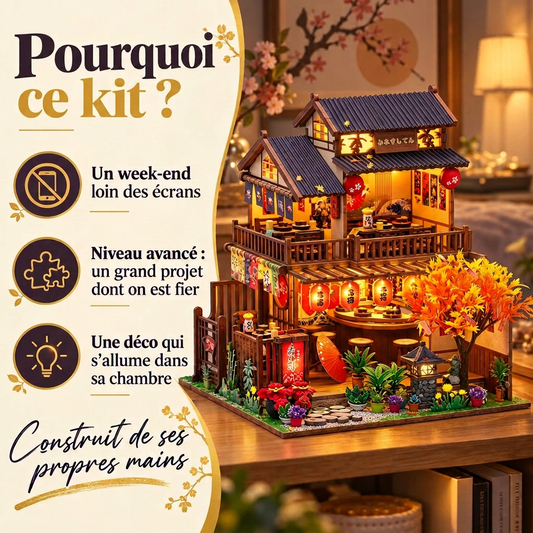
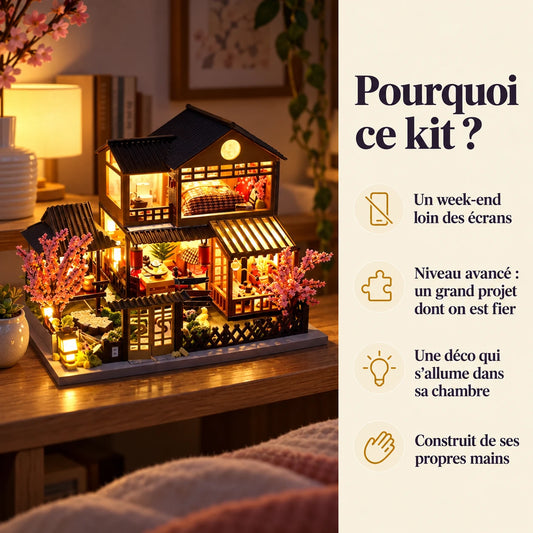
The Cherry Blossom Parlor is one of the biggest houses in the catalog: two floors, a rock garden, 478 pieces, 19 cm wide by 17 deep, and double lighting, inside and in the garden. It's an advanced-level project to savor over a weekend. The Cherry Blossom House brings the same under-the-sakura mood in a more compact format, 258 pieces, still multi-story, still beneath the pink blossoms. Together with The Riviera Villa, these three multi-story houses make up our selection of wooden model houses.
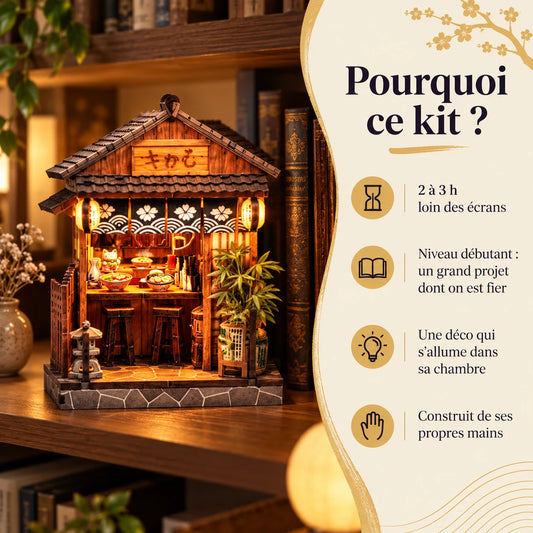
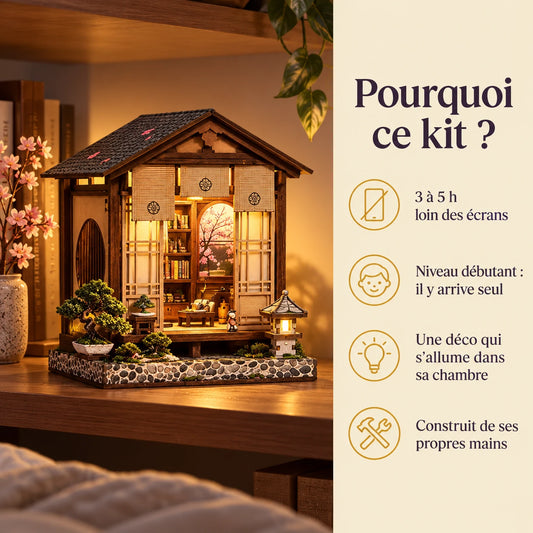
The Bonsai Pavilion is the ideal way into the collection: a small beginner-level teahouse, 150 to 220 pieces, whose shoji door opens onto a majestic bonsai. And Little Izakaya, our starter format, comes together in two to three hours with its 96 pieces: a Japanese tavern, its red lanterns, and the instant effect of a glowing facade.
Houses beneath the cherry trees, the collection's signature
Sakura is to the Japanese house what the lantern is to the alley: the detail that sets the scene at a glance. The Cherry Blossom Parlor and The Cherry Blossom House both play on the contrast between the wooden facades and the pale pink blossoms spilling over the roof; lit up in the evening, the windows turn golden and the petals catch the light from below. They're the two most photogenic models in the series once finished.
What makes a Japanese model
You can recognize a Japanese miniature house by a few features that come back from one kit to the next: shoji sliding doors and their wooden grid, gently sloping roofs, paper lanterns, noren curtains hanging across a shop entrance, and inside, low tables, folding screens and light wood furniture. Depending on the kit, you'll find some of these features, never copying a real building: each house is an imagined scene, not a replica of a specific place, and none is tied to a licensed movie, manga or saga.
The light does the rest. An openwork wooden facade diffuses the warm LED like a real pavilion lamp, which is why Japanese houses are among the most beautiful models to light: it's an architecture made to be seen lit from within, and the miniature version makes the most of it.
Miniature house or Japanese book nook?
The two share the theme and the laser-cut wood, but not their place in the room. A book nook slides between two books and is viewed head-on, like a window opening onto your bookshelf: Kyoto Alley and Sakura Rain are the classic examples. A miniature house, on the other hand, sits on a piece of furniture and can be seen from every side: several facades, often several floors, furnished rooms you discover as you walk around it. If you're looking for the bookshelf format, the whole series is in our Japanese book nooks; if you're looking for the house format, you're in the right place, and the other moods are gathered in our DIY miniature house kits.
Building a Japanese miniature house
Each box contains the laser-cut wooden sheets, the decor and miniature furniture, the LED lighting and illustrated step-by-step instructions in English. There's nothing to cut or paint: regular wood glue (not included) and precision tweezers are all you need, and the tweezers come free with the book nooks and miniature houses.
You build level by level: the ground-floor floor and walls, the furniture, the upper floor, then the facades, the sliding doors, the roof, and the LED at the point shown in the instructions. Plan one session for Little Izakaya, a few evenings for The Bonsai Pavilion, and a relaxed weekend for the Bazaar or The Cherry Blossom Parlor. The glue dries between sessions; there's no need to finish in one go, and it's actually more enjoyable to come back to it for an hour each evening, the way you'd pick up a novel. Our article on the difference between a miniature house and a book nook helps you choose between the two formats.
A model that decorates, not just a project
Once built, the Japanese miniature house becomes a decor piece in its own right: on a console table, in a display cabinet, on an office shelf. Lit up in the evening, it doubles as an ambient night-light—a soft glow behind wood that calms a room like few objects can. That's the double appeal of this creative hobby for adults: a few evenings away from screens, hands busy, and an object that stays and that you'll look at for a long time.
Built one after the other, the Parlor and the House sit side by side and form a little neighborhood beneath the blossoms; the consistent style across the kits in the series lends itself to it, and that's often how a collection begins.
Japanese model kit FAQ
Which Japanese model should you start with?
The Bonsai Pavilion, at beginner level, or Little Izakaya for a short first build. The Kyoto Bazaar is the right choice if you've already built a kit and want a longer project.
Do you need to paint or cut anything?
No. The wood is laser-cut, the decor is included, and the instructions show every step. All you need is wood glue, tweezers and batteries for the LED.
Do these houses replicate real places?
No. They're inspired by traditional Japanese architecture—shoji doors, lanterns, noren—without copying an existing building, and no kit is licensed, whether from a movie or a manga.
How long does The Cherry Blossom Parlor take?
A relaxed weekend, or one to two weeks at an hour a night. It's the longest model in the series, and the one with the most detail once finished.
Want to compare with the rest of the catalog? All our kits are sorted by build time on our craft kits for adults page, and the bookshelf format in all our book nook kits. All our wooden kits, from a building point of view, are on the 3D wooden puzzles page. For a model of an object rather than a house, head to our wooden model kits page.
